Download the resources you need for each session
There are self-printable question cards for every session, to help aid your conversations as a group as you discuss each topic. We have also provided work sheets for the suggested activities that appear in some of the sessions.
These are not necessary to run Koble (the homegroup guide contains all the questions and activities), but we think many people will find these a useful addition.
Explore extra information for each session, with suggestions for additional reading, extra ideas, and helpful resources from other organisations.


Session Introduction
If you’ve ever travelled on a motorway, you’ll know they aren’t generally designed for enjoying the view. They’re built to get you from one place to another as quickly as possible. And while some stretches might offer glimpses of pleasant scenery, the speed, the need to focus, the signs, roadworks, traffic volume, and embankments usually leave little room to notice what lies beyond the hard shoulder.
But beyond every mile of motorway are places, communities, and lives we don’t notice except from a distance, and with which we will likely never connect.
Sometimes, our personal lives or our church’s mission can start to resemble a motorway journey. We stick to familiar routes, talk with people we know, focus on getting things done, and keep our programmes moving. Yet, do we ever pause to ask where we’re really heading missionally, who we are serving, and who we might be missing?
Even churches with a heart for local mission can fall into a pattern of ‘doing what we’ve always done’ or adding another event or project, but rarely stepping back to ask whether this is making the difference we hoped for, or whether we are noticing what God is doing around us. It’s not that we’re inactive or failing to make a difference; it’s just that we can drift into autopilot, arriving at a destination and realising we don’t quite remember the journey.
In our eagerness to act, to help, to change the world, or simply to keep things running, we risk missing opportunities for new connections, growth, and transformation. We also sometimes forget that mission isn’t just for a few gifted individuals. We all have a part to play, and sometimes we need to stop and ask: Are we letting others take the wheel? Are we confident enough to take the wheel ourselves?
That’s why it’s so important to pause, to reflect, and to ask if there are new routes to explore, fresh stops to make, surprising places to notice, and even forgotten joys to rediscover.
Some people actively avoid motorways. They make it their mission to take the slower road, the one that winds through small towns and past old landmarks. It’s not the fastest, but it’s rich with unexpected moments, people to meet, and stories to share. When people take this route, they become, in a small way, everyday adventurers. What makes that journey meaningful is not just what they discover, but that they chose to take it.
So, as we begin this Koble journey, let this be your invitation to get off the motorway, to take time to reflect on where you are, how you feel about mission, what’s working well, what’s growing, what’s missing, and what might lie ahead.
Whether you feel your mission is thriving, stuck, or you haven’t thought about it in a while, let’s start by simply pausing, noticing, and seeing what God might want to show us next. After all, unless the Lord builds the house, we labour in vain.

Dig deeper into 'Discover'
The first session in Koble is an invitation to reflect on who you are currently reaching and serving in mission.
If you’ve ever travelled on a motorway, you’ll know they aren’t designed for enjoying the view. They are built to get you from one place to another as quickly as possible. While some stretches may offer glimpses of beautiful scenery, most motorway journeys are shaped by speed, concentration, traffic, road signs, and the steady focus of simply getting where you need to go.
But beyond every mile of motorway are places, communities, and lives we barely notice. There are hidden away people we pass at speed and may never meaningfully connect with.
Sometimes our mission can begin to resemble a motorway journey. We stick to familiar routes, talk to familiar people, keep programmes running, and focus on getting things done. Yet we rarely stop to ask deeper missional questions:
Who are we really serving?
Who are we missing?
Where are we sowing seeds and seeing growth?
Where are we experiencing harvest?
And where are there communities or opportunities we have barely noticed at all?
Churches and individuals benefit enormously from stepping back and honestly reviewing their mission. This kind of reflection is not about criticism or failure. It is an opportunity to celebrate what is healthy, recognise where change may be needed, and remain open to where God may be leading next.
Why review?
1. Mission drift happens naturally
Over time, even well-intentioned churches can drift. As individuals, our lives become busy, and as churches we can slip into routines that feel comfortable and familiar. Programmes that were once effective may continue simply because they have always existed, even if they no longer connect with people in the same way.
It is not that churches stop caring or stop serving. Often the opposite is true—we remain active and committed. But without reflection, we can drift into autopilot, like arriving somewhere and realising we barely remember the journey. Or like someone slowly drifting out to sea on an inflatable, only noticing the distance from shore when they finally stop and look up.
Taking time to review helps us notice where we are, where we are heading, and whether our current direction still reflects God’s calling.
2. Communities and culture change
Communities never stand still. New housing developments appear, demographics shift, and people’s habits, struggles, and rhythms change over time. Even something as simple as the time of day we meet or run an activity can affect who we are able to connect with.
A mission approach that worked well five years ago may no longer be as effective today – midst the changes happening about us. Reviewing mission helps churches stay attentive and responsive to the people around them rather than assuming yesterday’s methods will always meet today’s needs.
3. Stewardship and purpose
Churches have limited resources—time, energy, finances, and people. While God’s Kingdom resources are limitless, our practical capacity is not. Reviewing mission helps us think carefully and prayerfully about where our efforts are best placed and where they may bear the greatest Kingdom fruit.
It is easy to become busy with activities, events, and programmes without stopping to ask whether they are still helping us fulfil our mission. Reflection protects us from allowing activity to replace purpose.
4. Creating space for spiritual discernment
Stepping back creates space for prayer, listening, and discernment. It gives churches and individuals the opportunity to notice where God may already be at work and consider how they are being invited to join Him more intentionally.
Mission is not simply about creating plans for God. It is about learning to recognise His activity around us and responding faithfully.
5. Strengthening unity and shared mission
Mission is not reserved for a small group of gifted people. Every follower of Jesus has a part to play. Yet sometimes churches unintentionally place responsibility for mission onto a few confident individuals while others never discover their own role.
Reflection allows us to ask honest questions:
Are we creating opportunities for others to grow?
Are we making space for new people to lead and serve?
Are we confident enough to release responsibility as well as carry it?
When leaders and congregations revisit mission together, it creates greater unity, clarity, and shared ownership of the church’s calling.
6. Creating space for growth and new ideas
In our eagerness to help, serve, and simply keep things running, we can miss new opportunities for connection and transformation. Evaluation opens the door for fresh ideas, creative approaches, and new ways of engaging with people.
Sometimes growth begins simply by slowing down long enough to notice what has been there all along. Reflection creates space to ask honest questions about our habits, routines, and assumptions, while remaining open to the new things God may want to do.
7. Faithfulness to the Great Commission
Periodic review helps ensure that our mission remains aligned with Christ’s call to make disciples rather than simply maintaining tradition, comfort, or familiar routines. Mission was never meant to become static. It is a continual invitation to follow Jesus into the lives, communities, and places He calls us towards. To pause, think, reflect and review helps us to maintain an attitude of missional listening and remain open to new possibilities led by God’s Spirit.
Conclusion
Some people actively avoid motorways altogether. They choose slower roads that wind through villages, pass old landmarks, and create opportunities to stop along the way. The journey may take longer, but it often becomes richer—full of unexpected conversations, discoveries, and moments that would otherwise have been missed. In a small way, those travellers become everyday adventurers. And what makes the journey meaningful is not only what they discover, but that they chose to take a different route in the first place.
So, as you begin this Koble journey, let this be your invitation to step off the motorway for a while. Reflect honestly on where you are, notice what may have been overlooked, and remain open to the new missional routes God may place before you.
Mission mapping tool
To have long-lasting missional impact we need to know our communities inside out. Understanding the history of our neighbourhoods as well as following the story God is already writing. This mission mapping tool will help you do just that. What makes your community unique? What sets it apart? What is already happening?


Session Introduction
In the 1990s, a new bridge was built over the Choluteca River in Honduras. Soon after, Hurricane Mitch devastated the region. While the bridge remained mostly intact, the river changed course and the connecting roads were washed away — leaving the bridge stranded over dry ground. It became known as ‘The Bridge to Nowhere’.
We are living through significant spiritual, social, cultural, and technological shifts, alongside major challenges such as rising poverty and social dislocation, as many people experience disruptions in their sense of belonging, identity, or well-being — often resulting in feelings of alienation, disconnection, or a lack of purpose and meaning. The world is not what it was. For churches committed to sharing the good news of Jesus, this presents both a challenge and an opportunity.
Many in the UK today no longer share a basic understanding of the Christian faith. The world we are called to reach is now spiritually unfamiliar ground, and the church isn’t always making the connections it could. Traditional methods of outreach often assume a familiarity with faith or the church that no longer exists. That means we must begin to think more like missionaries in our own neighbourhoods.
If we were going on an overseas mission, we’d need to spend time learning the language, culture, and worldview of the people we hope to reach if we had any hope of truly connecting. The same is now true in our own neighbourhoods.
The message of Jesus remains powerful and relevant, but the way we seek to share it may need to look different. Traditional attractional methods of mission, such as evangelistic enquiry courses or events, still hold immense value — but for many today, these may feel like starting in the middle of the story. They also don’t require us to make any adjustments; it is those we are trying to reach who need to shift and come to us. We are happy for them to enquire about us, but are we equally interested in them? People may also be spiritually curious but often lack the vocabulary, background, or experience to engage with faith in the ways we’re used to. It is also true that some people remain hostile to faith or have their beliefs deeply rooted in other faiths. Where we are seeing a growth in church attendance, this doesn’t mean deeper faith. Many are just beginning their faith journey and need space to explore, build relationships, ask questions, and see faith lived out authentically.
Despite many missional successes, churches and individual Christians often find it challenging to reach those outside the church or draw people to events and enquiry courses. Even when initial connections are made, helping others grow in their faith or sparking meaningful spiritual conversations beyond the everyday can be difficult. These observations reveal a missional gap — a disconnect between where the church is and where people in the community are. Yet these, and other gaps you may notice, can be bridged.
Notwithstanding that God often breaks through in amazing ways with little intervention from the church, we might still need to adapt, evaluate, rethink and reshape our approaches to mission. This idea of adapting is not a new concept. As the early church made its way into all the world, you can guarantee they constantly had to find new ways to tell the same Good News.
In Honduras they eventually reconnected the bridge. They accepted the reality of what had shifted and found a way to navigate the changes. It is still the same bridge but with new connections. We are the same church, with the same message and the same God; we just have to be prepared to re-evaluate and consider how we make new connections in world that has shifted.

Dig deeper into 'Difference'
To continue laying the foundation for Koble, this section explores the changing missional landscape and considers the possibility that we may need to approach mission differently (or at least more broadly). It also invites us to think honestly about some of the gaps that now exist between the church and the people we are trying to reach.
In the 1990s, a new bridge was built over the Choluteca River in Honduras. Soon afterwards, Hurricane Mitch devastated the region. Although the bridge itself survived, the river changed course and the roads connecting to it were washed away. The bridge remained standing, but it no longer connected to anything. It became known as “The Bridge to Nowhere.”
In many ways, the church today faces a similar challenge. The Gospel has not failed. God has not changed. But the cultural landscape around us has shifted dramatically, and many of the routes that once naturally connected people to church and faith no longer exist in the same way.
We are living through significant spiritual, social, cultural, and technological change. Poverty is rising, communities are fragmenting, and many people experience deep loneliness, uncertainty, and disconnection. Questions of identity, purpose, belonging, and meaning sit close to the surface for many, even if they are rarely spoken aloud.
At the same time, fewer people in the UK today hold a basic understanding of the Christian faith than at any point in recent history. The UK has been described as entering its first “atheistic age,” with fewer than half the population identifying belief in God. The Christian story, language, and assumptions that once shaped wider culture are no longer widely shared.
Yet the picture is not entirely bleak. There are signs of renewed spiritual curiosity. Church attendance in some contexts is increasing, and Bible sales have risen significantly in recent years. Many people are spiritually open, even if they would never describe themselves as religious.
This creates both a challenge and an opportunity for the church.
A different starting point
The issue is not that people no longer ask spiritual questions. Often, it is that the church and wider culture are starting from very different places.
The answers we are offering may not connect with the questions people are actually asking. The language we use may feel unfamiliar. Many people have little understanding of Christianity beyond stereotypes, media impressions, or fragments of cultural memory. Others may hold spiritual beliefs shaped by different religions, personal experiences, or popular spirituality.
For some, spirituality has become disconnected from organised religion entirely. People may talk about mindfulness, wellbeing, purpose, peace, or the soul without having a framework for understanding faith in a Christian sense. Others simply bury spiritual questions beneath the pressures and distractions of daily life or do not connect the idea of spirituality to what it is they are thinking about.
Yet beneath the surface, many people remain spiritually curious.
Curiosity, however, is not always the same as seeking.
Someone who is curious may ask questions, explore ideas, or show interest in prayer, church, or the Bible without necessarily intending to change their life or beliefs. Seeking is different. Seeking involves movement—a desire to discover whether God is real and whether faith might genuinely shape someone’s life.
Others, however, may appear indifferent, sceptical, or even hostile toward faith and the church. For some, spirituality is buried - this aspect of who they are is unknown to them. Others on the other hand may still carry fragments of a Christian frame of reference from childhood, school, family, or culture, but have never meaningfully engaged with it—or may have consciously rejected it at some point along the way.
Understanding these differences matters because many people today are much earlier in their spiritual journey than churches sometimes assume.
Meeting people where they are
For decades, many evangelistic approaches assumed a basic understanding of Christianity. People may not have been committed believers, but they often understood the language, values, and story of the Christian faith. That is no longer true for much of society.
Traditional evangelistic courses and events still have immense value, but for many people today they can feel like entering halfway through a conversation. Some people are spiritually interested but lack the background, confidence, or vocabulary to engage in those settings. Others may find information-heavy approaches difficult without first building relationships and trust.
This does not mean the Gospel is less powerful. It means we may need to begin further back.
Most people do not move quickly from no faith to mature faith. Spiritual journeys are often gradual, relational, and shaped by experience over time. Some people remain curious for years before becoming active seekers. Others encounter God unexpectedly and respond rapidly. God is always able to work beyond our expectations or methods.
But generally, people need opportunities to encounter authentic Christian community, ask honest questions, explore faith safely, and experience the reality of Jesus through relationships as well as explanations.
Understanding the world around us
If we hope to connect meaningfully with people, we need to understand something of how they see the world. Australian sociologist Hugh Mackay describes worldview as a kind of cage. The “bars” of the cage are the beliefs, assumptions, experiences, and cultural influences that shape how people interpret life.
For example, someone who assumes miracles cannot happen may dismiss the supernatural elements of Christianity immediately. Someone shaped by disappointment or mistrust may struggle to believe in the goodness of God or the authenticity of the church.
Understanding these “bars” does not mean compromising the Gospel. It means listening carefully enough to communicate in ways people can genuinely hear beyond their current would view.
- Some common features of contemporary culture include:
- Prioritising the present moment, with less emphasis on long-term continuity or tradition.
- People often trust experience more than authority – or take their authority from places without really knowing if what they are reading, seeing or hearing is really true.
- Authenticity matters more than expertise.
- Identity is increasingly flexible, with people shaping and reshaping who they are over time.
- Spirituality is welcomed more readily than organised religion.
- Belief systems, including faith, are often treated as personal and adaptable rather than fixed or authoritative.
- Belonging often comes before belief.
- Many people are searching for identity, hope, and meaning.
- Meaning and values are often created through lived experience, trends and social media influencers.
- Trust is built slowly through relationships and consistency.
- People are exposed to many competing worldviews.
The missional gap
Many churches and individual Christians genuinely care about mission, yet still experience frustration when trying to connect with people outside the church. Common challenges include:
- Feeling unsure where to begin
- Struggling with confidence in sharing faith
- Finding it difficult to move conversations beyond surface level
- Relying heavily on traditional events or courses that connect with fewer people
- Becoming so busy with church activity that mission drifts into the background
- Feeling disconnected from the people and culture around us
But gaps can be bridged.
The world we are called to reach may now feel like unfamiliar ground, yet this is not entirely new. The early church constantly adapted how it communicated the unchanging message of Jesus as it encountered different cultures, languages, and worldviews.
The Gospel remains true. Jesus remains relevant. God is still at work.
What may need to change is how we connect.
If we were preparing for overseas mission, we would expect to learn the language, culture, and worldview of the people we hoped to reach. Increasingly, the same mindset is needed within our own communities.
Mission today may require us to listen more deeply, build relationships more intentionally, create safer spaces for exploration, and become more aware of the questions people are genuinely asking. It may require us to move beyond expecting people to come to us and instead learn how to meet people where they already are.
In Honduras, the Choluteca bridge was eventually reconnected. The engineers accepted that the landscape had changed and built new roads accordingly. It was still the same bridge, serving the same purpose, but now connected differently.
The church remains the same church. We still hold the same Gospel and serve the same God. But if the landscape around us has shifted, we may need to rethink how we build connections beyond our traditional approaches to mission so that people can once again find a pathway towards Jesus.
Something to watch
A short film introducing the importance of praying over the area where we live. Produced by Local Houses of Prayer.


Session Introduction
Most Christians know about the Great Commission that Jesus gave explicitly to the first disciples but also implicitly to all of us who follow Him. That Great Commission says we are to "go into all the world and make disciples".
Each of us therefore, is called by God to live out our Christian faith and speak about our faith to those around us. But that can be difficult, scary or awkward. For numerous reasons, we can struggle to represent God or find mission a high priority within the many demands of life. Church can also get lost in the busyness of its activities, the job of maintaining our buildings and just keeping what we already do going.
It has been said that ‘the stronger the desire the greater the motivation’. What we desire will often drive our actions and determine our efforts and what we spend our time on. What do you desire? If you had to create a list of 100 things to do before you die what would be on it? Would mission be on that list?
It could be said that when it comes to local mission you either love it, are indifferent to it or just don’t like it. Simply being told to be missional is not likely to be a great motivator. So how do you think we can develop a desire for mission? What would motivate you?
Missional motivation cannot be forced but will often grow from the depth of our own relationship with God. As we read, pray and spend time with those both inside and outside of the church, we become open to seeing the world as He does. As our lives are transformed by His love, we align with His purposes. We begin to notice that God is on a mission and we are called to join in. We are reminded that Jesus is ‘good news’, and we are called to play our part in sharing that news. Ultimately, we have to lean on the truth that God so loved the world that He gave His only Son. That new and eternal life is found in Christ. That Jesus taught us to see people differently and has made us His ambassadors in the world.
In this session, we are going to look at how we can develop a desire for mission and connecting with those around us. Hopefully, as we focus on this theme of Desire and how it impacts mission it will focus our prayers for God to lead us and shape us, so in the middle of all that is going on in our lives, we will have a desire to live out and speak about our faith. As we start to live out the various aspects of mission found in Koble and ask God to help us grow our desire for mission, our focus should change. However, one thing is for sure: if we don’t desire it, and invite the Holy Spirit to ignite a desire in us, we probably won’t do it or find it as enjoyable as it could be.

Dig deeper into 'Desire'
Most Christians are familiar with the Great Commission Jesus gave to His disciples—and by extension to all who follow Him: to go into all the world and make disciples (Matthew 28:18–20).
Each of us is therefore called to live out our faith and speak about it with those around us. Yet for many, this can feel difficult, awkward, or even intimidating. Life is busy, church can become absorbed in maintaining activities and buildings, and mission can easily slip down the list of priorities. In addition, a changing cultural landscape adds further complexity to how we engage in mission today.
It has been said that “the stronger the desire, the greater the motivation.” What we desire tends to shape what we do, where we invest our energy, and how we spend our time. If everyone in your church were asked to list 100 things they wanted to do before they died, would mission appear on that list?
When it comes to local mission, people tend to fall into one of three broad categories: those who love it, those who are indifferent to it, and those who actively avoid it. Simply being told to “be missional” is rarely enough to create lasting motivation. So the real question is: how does desire for mission actually grow?
The missionary spirit
The first and most important truth is that mission is not carried out alone. When we engage in the Great Commission, we do so in partnership with the Holy Spirit. Jesus described the Spirit as a witnessing presence—One who testifies about Him and draws others to faith through our lives.
The early church in Acts accomplished so much not through human strength alone, but through the active involvement of the Spirit. He directed their steps, gave them boldness, shaped their words, and even prepared the hearts of those they encountered.
In Jesus’ upper room teaching (John 14–16), we see several key ways the Spirit works with us in mission:
1. The Spirit as helper (John 14:16)
Jesus promised the Spirit as a “Comforter” or helper—One who comes alongside us. In practice, this includes giving words when we need them, courage when we are afraid, creativity in how we respond, and power in prayer.
2. The Spirit dwells in us (John 14:18)
The disciples feared Jesus’ departure, but He reassured them that His presence would remain through the Spirit. The same Jesus who walked with them would now dwell within them. This was the source of their confidence and boldness—even when standing before authorities like the Sanhedrin in Acts 4.
3. The Spirit as teacher (John 14:26)
In a rapidly changing world, we often wrestle with how to live out faith, church, and mission. The Spirit teaches us, helping us re-engage with the words of Jesus and apply them freshly to our context.
4. The Spirit as motivator (John 15:26–27)
Witnessing is not always natural or easy. Fear, hesitation, and past disappointments can hold us back. Yet the Spirit prompts us inwardly, stirring courage and a desire to speak about Jesus when opportunities arise.
5. The Spirit convicts (John 16:7–11)
Ultimately, it is the Spirit who opens spiritual eyes. Conversion is not human persuasion but divine work. This is good news: no one is beyond the reach of God.
6. The Spirit as guide (John 16:12–15)
Often we find ourselves in unexpected conversations or “chance” encounters that turn spiritual. The Spirit guides these moments, shaping connections and opportunities as we live attentively and prayerfully.
Taken together, these truths remind us that mission is not a human project carried alone, but a Spirit-led participation in what God is already doing in the world. So, inviting God’s Spirit to lead us, open our eyes, inspire us and give us opportunities to share our faith opens our hearts and minds afresh to His work in us and the world around us.
Why people struggle to share their faith
Helping people share faith is not simply about instruction—it is often about motivation and renewal. Paul captures this in 2 Corinthians:
- Christ will be our judge and focus (2 Cor 5:10–11)
- Christ’s love compels us (2 Cor 5:14)
- Christ reshapes our desires and priorities (2 Cor 5:15)
- Christ changes how we see people (2 Cor 5:16)
- Christ commissions us as ambassadors (2 Cor 5:18–20)
- Christ calls us into urgent opportunity (2 Cor 6:2)
Often, people simply need regular reminders of these truths. Busyness and distraction can dull what we already know. Gentle encouragement can help reawaken a sense of calling.
But for others, deeper obstacles exist.
Personal barriers to faith-sharing:
- Fear — fear of rejection or embarrassment, and in some cases hostility
- Inadequacy — concern about not knowing enough
- Apathy — assuming others are not interested
- Distraction — being overwhelmed by life or church activity
- Personal doubt — internal struggles with belief or doctrine
- Disillusionment — feeling let down by God or unanswered prayer
- Perceived irrelevance — uncertainty about how faith connects to life today
- Identity pressure — needing to become someone else 'other than yourself'
At their root, many of these reflect a disconnect between calling and confidence, belief and practice, or desire and perceived ability. We need to be honest about our personal barriers and explore ways in which they can be overcome. In reality this is what Koble is trying to help us with too.
Creating a culture of desire
Developing a culture that releases intentional faith-sharers is complex, but several foundations are essential:
- Recognising that lost people matter deeply to God
- Leaders modelling everyday faith-sharing
- Embedding mission into the rhythms, teaching, and priorities of church life
- Investing time and resources into mission, not just maintenance
- Reinforcing that every believer is called to represent Christ daily
- Structuring church life to release rather than restrict mission
- Praying for those around us
- Exploring the various D’s of mission and practicing them.
Underlying all of this is a crucial shift: seeing church not as something we attend, but as a people sent into the world.
Conclusion
Desire for mission cannot ultimately be manufactured. It grows out of relationship with God, attentiveness to His Spirit, and a renewed vision of His heart for the world.
As we read, pray, and engage with both believers and those outside the church, we begin to see differently. People become more than statistics or challenges — they become individuals loved by God. We begin to recognise that God is already on mission, and we are invited to join Him.
We are reminded that God so loved the world that He gave His only Son, that new life is found in Christ, and that we are called to represent Him as ambassadors in the world.


Session Introduction
In 1896, minister and preacher Charles Sheldon wrote a book called In His Steps, in which the characters face difficult moral decisions. Throughout the book, Sheldon challenges readers to consider the question, “What would Jesus do?” when confronted with such situations, encouraging them to reflect on how they themselves should respond.
In the 1990s, a movement to help teenagers remember this phrase led to the creation of the popular WWJD bracelet and provided a daily reminder to apply the teachings of Jesus to our actions so that we may be distinctive.
What comes to your mind when you think about what it means to be distinctive as a Christian? What impression is portrayed in the media, or what do people outside the church think about us? Is it one that is reflective of the teaching and attitude of Jesus?
In the Sermon on the Mount, we read examples of Jesus’ teaching about living life God’s way. They essentially offer a description of the qualities and Kingdom characteristics of what it means to live for Christ. This passage, along with the rest of scripture, outlines a set of standards and attitudes that God wants to see in us and then reflected out to the world.
Following the teachings of Christ should make us distinctive, shouldn’t it? Is it true that our words and actions are powerful? Do they matter? If we can say, yes, they do, we should apply caution, and remind ourselves that our true distinctiveness is not just being religious or about what we know, but also who we know. It is, after all, surely Christ’s righteousness that we carry, and it is from our relationship with Him, following His example of love and humility, that we can begin to live out the words of scripture and do as He did.
So, in this session we begin to explore what living a distinctive, attractive lifestyle looks like. As we explore distinctiveness, maybe we could pause the WWJD slogan to ask first, ‘How Was Jesus Distinctive?’, What sets us apart? Where does it come from? What should the wider world see in us? How can I make sure I remain close to Him? What does He want to change in me to make me more like Him, so true distinctiveness flows? Or in the words of the writer and podcaster John Mark Comer, “Be with Jesus, Become Like Him and Do as He Did”.

Looking good — living attractively
In 1896, minister and preacher Charles Sheldon wrote a book called In His Steps, in which the characters face difficult moral decisions. Throughout the book, Sheldon challenges readers to consider the question, “What would Jesus do?” when confronted with such situations, encouraging them to reflect on how they themselves should respond. In the 1990s, a movement to help teenagers remember this phrase led to the creation of the popular WWJD bracelet, providing a daily reminder to apply the teachings of Jesus to our actions so that we may live distinctively.
What comes to your mind when you think about what it means to be distinctive as a Christian? What impression is portrayed in the media, or what do people outside the church think about us? Is it one that reflects the teaching and attitude of Jesus?
In the Sermon on the Mount, Jesus outlines what life in the Kingdom looks like. It is a picture of the values, character, and attitudes of those who follow Him. Alongside the wider teaching of Scripture, it gives us a vision of lives shaped by God and visible to the world around us.
In practice, many people come to faith through a similar pattern:
- They notice that a Christian friend lives differently in some way, similar to them in some things (we don’t need to be weird), yet distinct. That difference sparks curiosity.
- Curiosity leads to conversation.
- Conversations gradually open up spiritual themes, often in small, informal moments.
- Over time, invitations follow, church gatherings, events, courses, meals, or shared experiences.
In 1 Peter 2:12, Peter writes to believers who feel out of place in their culture.
Surrounded by values and expectations that often conflict with their faith, he encourages them to live “good lives” among those around them. This phrase carries the sense of living in the most beautiful, compelling, and attractive way possible.
In other words, the goal is not withdrawal or imitation, but a distinctive life that draws attention to God through the quality of how we live.
Underlying questions
As we think about what an attractive Christian life looks like, several key questions help guide us:
- What does our culture value that is already consistent with Scripture, and how can we live those things well? Kindness, peace, having purpose, finding strength in tough times.
- What does Scripture affirm that culture is neutral about, and how can we model that clearly?
- Where do Scripture and culture conflict, and can we explain our convictions with clarity and grace rather than assumption or reaction?
What does an attractive lifestyle look like today?
An attractive Christian life is not about perfection, but about a pattern of life that reflects the character of Jesus in everyday ways. Some key expressions of this include:
The presence of hope
In a culture often focused on the present moment, many people still carry a sense that life must mean more than what is immediately visible. Christians who live with hope, especially in uncertainty or suffering - stand out. This hope shapes priorities, resilience, and how we face loss or difficulty.
How we do community
In an individualistic culture, genuine community is increasingly rare. The church has the opportunity to model a different way of living, where people are known, valued, and committed to one another, even through tension and difference.
The way we cope with difficulties
Everyone faces hardship, but not everyone has a framework for navigating it. A life shaped by trust in God and supported by Christian community can stand out through resilience, honesty, and peace in difficult seasons.
Hospitality
Loneliness is widespread in modern society. Simple acts of welcome, shared meals, and openness to others create spaces where people experience belonging and care. Hospitality becomes a lived expression of love.
Citizenship
Christians are called to live responsibly within society, seeking justice, engaging thoughtfully with public life, and responding to injustice with wisdom rather than reaction or withdrawal.
Caring for the planet
Stewardship of creation is part of faithful Christian living. Growing awareness of environmental responsibility gives the church an opportunity to model care, responsibility, and action in how we treat the world around us.
Celebration
Joy is often under-expressed in Christian communities. Yet celebration of life, of others and of God’s goodness is a powerful witness in a culture often marked by anxiety or pressure. An attractive Christian life knows how to rejoice well.
Meaningfulness
Many people quietly wrestle with questions of purpose. A life rooted in Christ carries a sense of direction and meaning that is not dependent on success or circumstance, but on identity and calling.
Work attitude
Work is often experienced as pressure or obligation. Christians have the opportunity to model diligence, integrity, and purpose in work - seeing it not only as necessity, but as service and vocation.
Authentic spirituality
Spirituality is widely explored today, but often disconnected from church. A lived, honest, and grounded spirituality, rather than performance or formality can help reconnect people with the reality of God.
Distinctiveness that points beyond us
Courses like Ten by J. John, based on the Ten Commandments, have shown that people remain deeply interested in questions of ethics, meaning, and behaviour. This reflects a continuing desire to understand how to live well. Many of our courses at the Ugly Duckling Charity explore the themes of happiness and how to live life well from the basis of Christian values and beliefs. People are interested in living well – so we have an opportunity to model it.
But Christian distinctiveness is never simply about behaviour or knowledge. It is rooted in relationship. It is not just what we do, but who we belong to.
Ultimately, what sets us apart is Christ Himself, His righteousness in us, His Spirit at work through us, and His life shaping ours. Distinctiveness flows from closeness to Him.
So as we reflect on what it means to live attractively, perhaps we move beyond simply asking, “What would Jesus do?” and also ask deeper questions:
How was Jesus distinctive?
What shapes that distinctiveness in me?
What might others see in my life that points beyond me to Him?
How do I stay close enough to Jesus for His life to shape mine?
As John Mark Comer puts it, we are invited to: “Be with Jesus, become like Him, and do as He did.”


Session Introduction
In the Bible, Christians are occasionally referred to as ‘aliens’ and ‘strangers’. The word ‘stranger’ carried the idea of ‘sojourner’, someone who resides temporarily in a place, with more of a focus on their heavenly destination. The downside of living like someone en-route to somewhere else is they can fail to live deeply with those around them.
In John 1:14 we are told that The Word became flesh and dwelt amongst us. Out of the 132 contacts recorded’ in the Gospels that Jesus had: 6 were in the temple; 4 were in the synagogue and 122 were out in the mainstream of life. Although Jesus did not start His formal ministry until He was thirty, He spent decades amongst the culturally and religiously diverse people of Galilee. He knew how to be ‘In’ the world, yet ‘not of it’. Jesus loved to reach out and Dwell with people in all sorts of situations, listening to their stories, giving them time and making them feel valued. This dwelling demonstrated the glory of God and transformed lives.
Just like Jesus we have so many connection points, or mission fields where we could dwell. This includes the natural geographical area where we live, socialise, work and study but can also extend to include a sphere of life where we see a need or an interest we want to pursue. The challenge is that we don’t just ‘live’ where we live but that we ‘dwell’ there and yes there’s a difference.
Let’s pause to think about three approaches to mission: Passive, Attractional and Incarnational.
Passive Mission is where we don’t do much to intentionally engage with those outside of the church, beyond hoping people will simply wander into our Sunday services or other events we hold. This can and does happen, especially if your church has a website or online service where people can learn more. God is also at work in people’s lives, and many are searching, sometimes looking to the church for answers even if we have never connected with them before. Even if our approach to mission is passive, it’s valuable to reflect on our welcome and consider how we could make what we already do more missional and accessible.
Attractional Mission is where we intentionally seek to invite people to services, events, programmes and courses that we put on. In these cases, we expect people to come to us. Attractional events often seek to engage with people through advertising or personal invitation. These are the most common of missional approaches used by churches and are a worthy and important aspect of mission.
Incarnational Mission is where we choose to actively spend time with people where they are. We can either get involved in local clubs, or with friends and neighbours socially, or move some of your own events and programmes into the spaces and places people already dwell.
Dwelling means we become good neighbours, we get involved in community life and spend time interacting with people at a deeper level. As we dwell, we begin to demonstrate value, we take notice of others, and they take notice of us. Dwelling builds relationships where people can start to share their stories, and we share ours.
Through the act of dwelling, God uses our lives to communicate the good news and show His goodness. God is a missional God. We see throughout the Bible how God reached out in love. As God stepped out and dwelt amongst us we are called to go and do the same.
To dwell effectively, we need to think about being ‘in’ the world, without denying the call to live distinctively as we inhabit it. We should pause and ask who the people are in our community. Who are we not connecting with? Who are we avoiding? Whose paths do we cross? How deep are the connections we already have? We may need to take time to reflect on our busyness, our priorities, our friendship groups, and where we devote our time. Are we just living, or are we dwelling?
As we think about how Jesus left His heavenly home and came to dwell amongst us, let’s explore what it means to leave our homes and dwell with those around us. If faith is most effectively shared in the context of meaningful friendships and friendships are built over time, then how do we inhabit the spaces in which we find ourselves?

Dwell
In the Bible, Christians are occasionally referred to as “aliens” and “strangers.” The word “stranger” carried the idea of a sojourner, this someone temporarily residing in a place, focused primarily on their heavenly destination. The danger of living only as people “on the way through” is that we can fail to live deeply among those around us now.
In John 1:14 we are told that the Word became flesh and dwelt among us. Out of 132 recorded encounters Jesus had in the Gospels, 6 were in the temple, 4 were in the synagogue, and 122 were in everyday, mainstream life. Although Jesus did not begin His public ministry until He was thirty, He spent decades immersed in the culturally and religiously diverse life of Galilee. He knew how to be in the world, while not being of it.
Jesus loved to dwell among people, listening to their stories, giving them time, and treating them with dignity. This dwelling revealed the glory of God and transformed lives.
Just like Jesus, we have many natural connection points and mission fields where we can dwell. These include where we live, work, study, and socialise, but can also extend into areas of interest, service, or calling. The challenge is that we don’t simply “live” in these spaces but we dwell in them. And there is a difference.
Let’s pause to consider three approaches to mission: passive, attractional, and incarnational.
Passive Mission
Passive mission is where little intentional engagement takes place beyond hoping people will come to church events or services. This does sometimes happen, especially through online presence or unexpected curiosity. God is also at work beyond our awareness, and people do occasionally find their way in.
Even so, passive approaches can miss opportunities to build deeper relationships with those who visit or connect briefly. It is worth asking how we can extend welcome beyond first contact and begin forming genuine relational connection, rather than immediately moving people towards structured courses they may not yet be ready for.
Attractional Mission
Attractional mission is where churches intentionally invite people to events, services, courses, or programmes. This “come and see” approach remains a vital and valuable part of mission.
It relies on communication, invitation, and hospitality, and often works best where some relational connection already exists. Most churches will naturally use this approach in some form, and it continues to play an important role in helping people explore faith.
Incarnational Mission
Incarnational mission is where we intentionally go to where people already are. This may include community groups, workplaces, social spaces, or everyday relationships. It may also involve shaping aspects of church life to exist within those spaces rather than expecting people to always come to us.
This is what it means to dwell.
Dwelling involves becoming good neighbours, engaging in community life, and investing time in real relationships. It is in these shared spaces that people begin to know us, and we begin to know them. Stories are exchanged, trust grows, and faith is communicated not only through words but through presence and relationship.
God is a sending and dwelling God. Throughout Scripture we see Him moving toward people in love. In Christ, God Himself dwelt among us. We are therefore called to do the same.
Identifying our mission field through social networks
Much church mission in the UK has historically focused on attractional approaches—events, courses, and services designed to draw people in. Typically, those who attend are connected through existing relationships: friends, family members, colleagues, or those linked to church activities such as community groups.
A simple invitation is given over coffee, in conversation, or through church communication and sometimes it is accepted. These approaches matter deeply, but they depend heavily on the strength of our relational networks.
In The Rise of Christianity, Rodney Stark argues that the early church grew largely through relational networks, people sharing faith within existing relationships rather than through large-scale public campaigns.
Even today, despite digital communication and increased mobility, most people still come to faith through trusted relationships. Word of mouth remains one of the most powerful forms of communication. Often, conversion begins not with arguments, but with the influence of a trusted friend whose life raises questions.
This pattern can even be seen in Jesus’ own ministry. Andrew follows Jesus because of John the Baptist’s witness, then brings his brother Peter. Philip and the others are similarly drawn through relational connections.
Faith spreads through relationships.
Identifying our relational networks
While most people recognise that relationships matter, it is easy to assume that everyone in our existing networks is ready for invitation or spiritual conversation. In reality, relationships develop over time, and not all connections are at the same stage.
Dwelling is not simply a means to an end or a stepping stone to invitation. It is about being present, being known, and knowing others without agenda or pressure. It is about becoming part of people’s lives in a genuine and sustained way.
Many churches still define mission primarily in geographical terms—the people who live around the church building. While this remains important, it is only one part of a much wider picture. Today, we are part of multiple overlapping networks, and mission often happens within them. These include:
Geographical Mission Field
The people who live near the church. This is often the default focus and is largely reached through attractional mission.
Church-Associated Networks (friends and family)
Those connected to church life through family, friends, or involvement in activities such as youth work, parents groups, community events or the work place. This is often the most significant but under-recognised mission field.
Minister’s Network
Connections formed through civic life, schools, community leadership, and local engagement. These relationships often open unexpected doors for witness.
De-churched
Those who once had meaningful church involvement but are no longer connected. Their history often provides both familiarity and complexity in faith conversations.
Church Fringe
People loosely connected to church life, attending occasional events or linked through family or social relationships.
Church Burden
People or groups God places on our hearts who may not naturally fall within our existing networks. These often require intentional stepping out in faith.
Prophetic Edge
New or unexpected areas of connection revealed through prayer and discernment. These are often unfamiliar spaces where God invites us to dwell.
Reframing missional practice
One reason some evangelistic approaches appear less effective over time is not the quality of the material, but the assumption about where people are starting from. Often, there is an overemphasis on drawing people to events, rather than building the relational foundations that make engagement possible in the first place.
Dwelling is not optional or secondary to mission — it is foundational.
Some key principles include:
- Notice where God is already at work and join in.
- Invest time intentionally in relationships and networks before expecting invitation or response.
- Build depth in existing relationships while remaining open to new ones.
- Pay attention to timing, context, and readiness, not just opportunity.
- Avoid separating mission from everyday life — dwelling happens in ordinary spaces.
Are we dwelling or just living?
To dwell effectively, we must live “in” the world while remaining faithful to Christ’s call to live distinctively within it. This requires reflection on our priorities, relationships, and rhythms of life.
Who are we actually connecting with?
Who are we overlooking?
Whose lives do we consistently pass but rarely enter?
How deep are our existing relationships?
Jesus left His heavenly home to dwell among us. In the same way, we are called to move toward others — not simply to live near them, but to truly dwell with them.
If faith is most effectively shared through meaningful relationships, and relationships are built over time, then the question becomes clear: how do we intentionally inhabit the spaces God has already placed us in?


Session Introduction
Have you ever tried to avoid someone with a clipboard on the street, or found yourself in a conversation where you felt unheard, uncomfortable with the topic, out of your depth, or where the other person believed they were totally right? People tend to avoid conversations when they feel uncomfortable. While casual conversations about the weather are easy, meaningful dialogue is more challenging.
Our ability to have deeper conversations often depends on the topic, personal experiences, context, and comfort levels. In today’s polarised world, people are also less receptive to being told what to believe, especially when it challenges their existing views. Religious language can also feel foreign, making discussions about faith even tougher. The end result might see people avoiding us, or we might avoid them.
Conversations may end up being stuck on a superficial level, or we can miss the opportunity to talk about what matters to others. We can also forget to truly listen because all we want to do is give people a set message or talk about what we want to say.
“Preach the gospel at all times and if necessary, use words,” is a quote attributed to Francis of Assisi, suggesting that our actions can be our most powerful message. However, relying solely on actions could be limiting — after all, Christians don’t have a monopoly on kindness. Therefore, we surely need to say something.
Missional conversations are likely to be more effective when they are rooted in genuine dialogue, not preaching. Jesus often began with everyday topics, listening first and addressing people’s needs alongside questions of faith.
We live in a time of increasing loneliness, mental health struggles, and spiritual searching. There are lots of situations and topics in life that, given the opportunity and the right environment, people would willingly talk about. For many, life’s biggest questions go unspoken — not because they don’t matter, but because it’s hard to find or create a safe space to explore them.
Meaningful conversations require us to listen to people, consider the context, be attentive to the Holy Spirit, and be patient and open. We don’t have to begin with an agenda; instead, we can meet people where they are. When we focus on listening, asking questions, sharing stories, and showing vulnerability, our conversations can lead to unexpected places, including life’s deeper issues. As you talk eventually something of your faith story will come out and it will happen naturally and authentically. This approach opens space for the Holy Spirit to guide us, and for God to speak through our interactions.
Many people welcome the opportunity to discuss what matters to them if they feel safe and respected. God is a conversational God, we see this in the Trinity and throughout God’s interaction with the world throughout history. God is already speaking and at work in people’s lives; He simply invites us to join in with His big conversation. So rather than panic, preach, or stay silent we can learn how to be ourselves, start where people are, and let God’s voice guide our conversations about the big and not-so-big questions of life. After all, it’s His voice that matters most and is what people truly need to hear.
So, as we reflect on the theme of dialogue, we will think about the conversations we’re having and those we are avoiding. We will consider how with gentleness and respect we can create spaces for deeper, more meaningful dialogue, which may in turn open the door for you to share the reason for the hope you have.

Dialogue
Have you ever tried to avoid someone with a clipboard on the street, or found yourself trapped in a conversation where you felt unheard, uncomfortable, out of your depth, or where the other person seemed convinced they were completely right? Have you ever wondered how to share your faith authentically without sounding preachy? Or perhaps you’ve tried to force a spiritual conversation only to find people disengage, become defensive, or politely listen without really connecting. While some people engage well in these types of situations, many will tend to avoid conversations when they feel pressured or unsafe.
We live in a fast-paced world, filled with noise and misinformation where effective dialogue often gets lost. Our society, increasingly polarised and aggressive, often prioritises shouting over listening and understanding. This approach rarely helps. Instead, it creates barriers, fuels anger, and deepens division.
This is where missional conversations become important: the way we talk with people is not separate from mission—it is often the very place mission begins.
The Bible speaks frequently about the power of the ‘tongue’ and how we can use our words either to stir up anger, hate and strife, or to bring hope, purpose and meaning into people’s lives. Even when we have good intentions our words can cause people to switch off. Sometimes we are so eager to deliver a set message or steer the conversation towards a certain topic like that of faith that we forget to slow down, to listen and pick up on what actually matters to the person in front of us. In doing so we can leave little room for patience, trust, vulnerability or for God to work.
Conversations, even when they are easy going, and everyone is comfortable can remain stuck at a superficial level. While we can probably all spark up casual conversations about the weather, meaningful dialogue is more challenging. Often people struggle to move beyond the superficial.
Great conversations, rooted in respect and compassion, really can change lives, yet it is easy to forget to appreciate the foundations for great conversations, and underestimate the simple power of conversation when it works well.
Our approach matters.
Words or actions? Recovering a both/and approach
Another danger in Christian mission is leaning too far the other way and believing we never need to say anything at all. “Preach the gospel at all times and if necessary, use words,” is a quote often attributed to Francis of Assisi, suggesting that our actions can be our most powerful witness.
To a degree this is true. Our distinctiveness matters — not as a performance or false show, but as the genuine outworking of God’s transforming work in our lives. Often it is this visible difference that prompts people to ask questions. However, relying solely on actions can be limiting. Christians do not have a monopoly on kindness or caring for the poor, and people may never make the connection between our behaviour and our faith unless, at some point, we are willing to speak.
Words matter too.
What is a missional conversation?
Very often when we think about sharing our faith verbally, we assume the only starting point is to present the Gospel message as we understand it, or immediately move into explicitly religious questions. Some people will respond to this approach; and at times this can feel right. However, there are times when that doesn’t work and not necessarily because they are rejecting Christianity, or you, but because of reasons already outlined: when we force topics on people, or because they do not yet understand how faith is relevant to their lives, or because they have fallen out of favour with faith due to previous life experiences.
Our studies in Koble on dwelling highlight the importance of spending time with people where they are. Missional conversations are often most effective when they begin in exactly the same way — rooted in genuine dialogue, everyday life, and authentic relationships, rather than arriving cold with a rehearsed message. Conversation about everyday topics can be missional even when we don’t start with words of faith.
This approach is not unfaithful to the call to share the Gospel as it can sometimes first appear. Jesus often began connection with people through ordinary life, listening first and addressing people’s experiences, questions, and needs alongside matters of faith. I think we can be confident that Jesus talked about many different topics with people throughout His life – not just the Kingdom of God – yet at the right time – the right moment came to say more.
In Acts 17, Paul speaks to the philosophers in Athens by beginning with something familiar to them, an altar “To an Unknown God.” Paul listens first, understands their beliefs and culture, and then connects their spiritual searching to the story of Jesus. Paul does not begin with condemnation or a detached speech. He starts where they are and allows the conversation to move naturally toward the Gospel. Again the right moment came.
Everyday life as mission space
So what about today? People have many topics that can be a gateway to conversations: friendships, finance, raising a family, education, politics, ambitions, well-being, sport, hobbies, work, stresses, joys, hopes and dreams. There are many experiences and questions in life that people are willing to talk about when given the opportunity and a safe environment to do so.
“All it takes to kick-start a great conversation is a great question.”
Meaningful conversations require us to ask thoughtful questions about the whole of life, listen carefully, consider context, be attentive to the Holy Spirit, and remain patient and open. We do not always need to begin with an agenda; instead, we can meet people where they are.
As relationships and conversations grow, something of our own story and relationship with God will often emerge authentically rather than artificially. Sometimes this can come out of the most unexpected conversations.
What makes conversations life-giving?
- Conversations are powerful because they:
- Bring Joy: It is good to talk, and conversations often lead to moments of joy and laughter. It breaks down barriers. It unites us. This helps to build a connection.
- Build Relationships: Calm, caring and respectful conversations foster understanding and deepen relationships – the very foundation to going deeper with our own lives or fully.
- Share Stories: As we talk with others, we naturally share what we believe, trust and hope in, opening space for meaning and purpose to be explored.
- Solve Problems: Listening attentively and speaking thoughtfully helps us find common ground and navigate life’s challenges together.
- Reduce Stress: Calm conversations create peace and help lower tension and anxiety and helps us to be peace makers in a fractious world.
- Support Well-being: Conversation can combat loneliness and isolation by helping people feel heard and supported – this in turn helps us to share how we look after our well-being body, mind and soul.
- Break the Cycle of Anger: Respectful dialogue creates safe spaces where empathy and understanding can grow – this in turn can help people to explore topics they might have rejected before.
- Value Others: Conversations build empathy and remind us that people are not projects or problems to fix, or even avoid, but human beings who are wonderfully made and worth getting to know.
Practising missional conversation
When we focus on listening, asking questions, sharing stories, and showing vulnerability, our conversations can naturally lead towards deeper issues, including faith.
-
Tips for better conversations:
- Have Great Questions to ask: Keep some thoughtful questions ready — all great conversations begin somewhere. The Table Talk resources available from the Ugly Duckling Charity (including our online daily question) can help with this.
- Give Time: Meaningful conversations rarely happen when we are rushed – dwell with people and create the safe space to talk.
- Practice Active Listening: Give people your full attention and acknowledge their thoughts and feelings.
- Show Empathy: Seek to understand another person’s perspective and experiences.
- Reflect: Consider your own conversational habits. Are there topics you avoid, dominate, or become defensive about?
- Create Conversational Spaces: Host gatherings in cafés, pubs, homes, churches, schools or community spaces where people can safely explore life’s questions together.
Joining in God’s conversation
By embracing the power of conversation, we create space for people to discover life in all its fullness and follow the example of Jesus, who continually made time for life-changing conversations.
Many people welcome the opportunity to discuss what matters to them if they feel safe and respected. God is a conversational God. We see this within the Trinity and throughout His interaction with humanity across history. God is already speaking and at work in people’s lives; He simply invites us to join in with His greater conversation.
So rather than panic, preach, or stay silent, we can learn to be ourselves, start where people are, and allow God to guide conversations through both the big and not-so-big questions of life. After all, it is God who is at work in every conversation—and He often chooses to speak through them in ways we could not have imagine if we create the space for Him to lead.
Read an article on spiritual conversations.
Table Talk
Purchase a Table Talk resource or make use of our Daily Question page to get conversations going.
Something to try
Create a more formal Table Talk café or Table Talk space, either within your own context or out in the community — this could be within one of your existing dwelling spaces or by setting up a new one.

Session Introduction
We know from missional research that most people journey toward faith within the context of friendship with a Christian. As we have explored in the previous ‘D’s’, we’ve seen that, through friendship, our love for God and His heart for people should inspire us to live out our faith...
Session Introduction
We know from missional research that most people journey toward faith within the context of friendship with a Christian. As we have explored in the previous ‘D’s’, we’ve seen that, through friendship, our love for God and His heart for people should inspire us to live out our faith.
This should lead us to demonstrate a distinctive lifestyle, dwell with others, and engage in meaningful conversations with our friends by listening, asking questions, and sharing our stories. Building this part of our friendships and connections can take time, but what comes next?
It can often be helpful for our friends to connect with other Christians. It is important that we continue to support people towards a greater understanding of faith. The default thought is often to invite them to church or an enquiry course (attractional mission). Conversely, we might assume they’d never attend either and hesitate to invite them to anything at all. However, as we read through the New Testament, we see that a variety of spaces were used to invite people to spend time with those who believed and deepen those conversations that had already begun.
Jesus met with people as He moved through everyday life — on hillsides, fishing trips, parties, meals, the synagogue, people’s homes, and even on the beach. In Acts, we see interactions in lecture halls, prison cells, riverbanks, places of public debate, homes, and the open air—not to mention the countless other places that aren’t recorded. While some of the spaces we invite people to today may not have existed back then, there is clear evidence that faith was lived out and shared in many different contexts and wasn’t limited to one type of setting.
As we think about spaces we might invite people to today, it could be helpful to consider different stages or levels for these interactions across a range of incarnational mission and attractional mission. First, start by engaging with people on neutral ground in the spaces you or they already inhabit and socialise in. Spend more time with them and deepen those conversations. Then you might consider hosting a simple social gathering introrducing them to other Christians in a familiar setting.
Next, you could invite people to a conversation evening in a pub or café, a concert at church, or an event on a thought-provoking topic or start a book club. Later, you might introduce an early evangelism course like the Happiness Lab or Resolve, and eventually, invite them to an event at church, like a carol service or an enquiry course. (In the ‘Play’ section of Koble for this theme, you can explore these stages and brainstorm specific activities for each one.)
As we explore the theme of delivery, let’s consider what spaces we already have, or might want to create, to invite people into. These are spaces that help people engage more with us and with others of faith. We might also think about the spaces that we and our friends already inhabit, and how we could invite other Christian friends to be part of them, so our friends can meet others of faith in that way. In each of these spaces, we can continue developing our connection through dwelling, dialogue, and demonstrating our distinctiveness. We can also be in prayer, knowing that God goes before us, and if we take the plunge, our invitation could transform a life forever.

Deliver an invite
One of the most consistent insights from missional research is also one of the simplest: most people who come to explore Christian faith do so through a relationship with a Christian. Not through programmes, advertising, or even primarily through events, but through friendship.
That means the heart of mission is not first about strategy or structure, but about people learning to live open, intentional, and prayerful lives with those around them. As explored in the previous “D’s”, through friendship, our love for God and our growing understanding of His heart for people should inspire us to live out our faith. This should lead us to demonstrate a distinctive lifestyle, dwell with others, and engage in meaningful conversations with our friends by listening, asking questions, and sharing our stories.
As friendships deepen, so does the opportunity for honest conversation about life, meaning, and faith. But friendship alone is not the end of the story. The question is: how do we help those conversations go further?
Faith shared in many spaces
When we read the New Testament, one thing becomes immediately clear: faith exploration was never confined to one kind of setting or one level.
Jesus met people everywhere—on hillsides, at meals, in homes, at parties, in synagogues, on beaches, and while walking from place to place. Some encounters were deeply informal and relational. Others were more intentional moments of teaching or gathering.
The early church followed the same pattern. In Acts, we see the gospel shared in homes, lecture halls, riversides, prisons, marketplaces, and public spaces of debate. There was no single “model venue” for spiritual conversation because life itself was the context. Also the early church engaged in more than just evangelistic events. They provided for people, shared food, and again you can imagine held social events and much more.
The clear implication is this: faith is best shared through a variety of spaces, not a single platform.
If relationships are the starting point, then invitation is the next step. But invitation should not be thought of as a single moment or to a specific one size fits all event - it is more helpful to think in layers or stages.
People actually explore faith at different levels. Some engage from a distance out of curiosity. Others want to observe quietly before participating. Some are happy to attend socially, while others want to ask difficult questions or openly debate ideas. People are at different points in their openness to faith, and different spaces help people take different steps. Some people will move quickly in a faith journey – for others it could be much slower. 7 Years is often viewed as the average time it takes for someone to come to faith. Therefore we shouldn’t diminish the small steps, a maybe moments and the personal questioning and shifts people make in private that we don’t always see. There is value at each stage.
So what could these levels look like:
1. Everyday life (neutral ground)
Start where people already are by engaging with them on neutral ground in the spaces you or they already inhabit and socialise in. Spend time with them and deepen those conversations.
Think about:
- shared hobbies
- workplaces
- neighbourhood interactions
- cafés
- gyms
- walking groups
- sports clubs
2. Social connection with Christians
The next step may simply be introducing friends to other Christians in relaxed, informal settings—meals, gatherings, or social events where faith is present but not pressured.
Again, this can involve creating spaces intentionally or inviting Christian friends into spaces you already inhabit.
At the same time, wisdom is needed. Resist inviting twenty Christians to the pub to meet your one neighbour. The aim is for people to encounter Christians naturally, not feel overwhelmed by them.
The goal is simply to help people connect with others whose faith feels authentic and approachable.
3. Conversational and increased engagement spaces
As trust grows, it can be helpful to create opportunities for deeper dialogue and exploration.
These might include:
- café or pub discussion evenings
- themed conversation nights
- Table Talk Café spaces
- setting up a Renew Wellbeing project
- book clubs
- film discussion groups
- parent-and-toddler programmes
- men’s / womens breakfasts with a speaker
- warm spaces
- art exhibitions
- Christmas tree festivals
- flower festivals
4. Introductory faith / spirituality exploration
For those showing greater interest, more structured but still accessible environments can help people explore faith and spirituality more intentionally.
Examples might include:
- pre-evangelism courses such as The Happiness Lab or Resolve
- “Big Questions” evenings
- dinners with a guest speaker, comedian, or entertainer
- concerts with light Christian input
- testimony or interview evenings
- weddings/funerals and baptisms
5. Church-based or public events
Finally, there are moments when people may be ready to step into more explicitly Christian gatherings such as:
- enquiry courses like Alpha, Christianity Explored
- seasonal services
- Church celebrations
- guest services
- carol services
- Easter events
Different networks, different opportunities
This approach also helps us see that invitation is not one-size-fits-all. Different relationships open different kinds of doors.
Returning to the theme of Dwell, we can recognise the many different spaces where we already connect with people or could. In each of those spaces, we will likely use different approaches to invitation.
While knowing people personally remains the strongest starting point and the best — remembering that most people come to faith through friendship — it is also important to let people know about opportunities to connect, regardless of how well we know them. After all, we cannot personally reach everyone in our communities, but we can make people aware that welcoming spaces exist.
Friendship networks
Personal invitations to social or conversational spaces are often most effective here.
Church Community Networks
Those already on the fringe of church programmes may respond well to simple invitation tools such as postcards, flyers, or personal recommendations from trusted people.
Community connections
Engagement through schools, local groups, cafés, neighbourhood activities, or charities may involve both personal invitations and wider advertising.
Weddings, funerals, chaplaincy, and community involvement all create opportunities to gently make people aware of events and spaces for conversation.
Wider geographical reach
Local media, posters, websites, social media, and neighbourhood invitation campaigns can all help create awareness and openness.
Each context requires wisdom, but all share the same goal: creating meaningful opportunities for people to encounter Christian faith across different levels in accessible and welcoming ways.
“Think small as well as big. Sometimes inviting someone to a coffee morning or sports group can be just as significant as inviting them to a carol service”.
The most important step: actually inviting
All of this only matters if it leads to genuine, personal invitation.
For many Christians, that is the hardest step.
There are often real fears involved:
- “What if they say no?”
- “What if I can’t answer their questions?”
- “What if they feel judged or uncomfortable?”
- “What if I damage the relationship?”
The key is not pressure, persuasion, or performance, but warmth, honesty, and sensitivity.
There will also be times when wider advertising and public invitations are appropriate, even where relationships do not yet exist – so don’t miss out on those. However, personal invitation remains especially powerful because it communicates care, trust, and intentionality.
A good invitation:
- is personal, not generic
- is face-to-face where possible
- gives clarity about what to expect
- removes pressure to continue if it is not for them
- reassures the person that the relationship matters more than their response
A way of life, not a one-off strategy
At its heart, this approach to invitation is not about running better events or using better tools. It is about cultivating a way of life where Christians are:
- attentive to relationships
- intentional about creating space
- sensitive to where people are spiritually
- willing to take small relational risks
- prayerful about opportunities
Conclusion: creating space for God to work
In the end, invitation is not about control, it is about participation.
We create space, we build relationships, we offer opportunities, and we trust that God is already at work in people’s lives long before we speak to them.
The challenge is not simply to invite more people to events, but to become the kind of people and communities who naturally create multiple welcoming spaces where faith can be explored over time.
As you explore the theme of delivery, consider what spaces you already have, or might want to create, to invite people into. These are spaces that help people engage more with us and with others of faith. Think too about the spaces that you and your friends already inhabit, and how you could invite other Christian friends to be part of them, so our friends can meet others of faith in that way. Also, think are there any of these more informal lower level events we could advertise and open up to others and not just focus on advertising the big events.
In each of these spaces, we can continue developing our connection through dwelling, dialogue, and demonstrating our distinctiveness. We can also be in prayer, knowing that God goes before us, and if we take the plunge, our invitation could transform a life forever.
Something to read
Over many years Andy Frost has been involved in church events, this booklet is a summary of what he’s learnt over the years and some of the key considerations that can make a church event a success. This booklet primarily focuses on events that help people explore and encounter the Christian faith.
Resolve
Explore running a course like Resolve, which is a four-week course designed to help people make life-long positive changes in the New Year. Each week delegates explore what the experts have to say about each topic, discuss as a group what they think and engage in a variety of practical exercise to help them accomplish their goals.


Session Introduction
When people in the Bible make significant life changes in response to Jesus, it often seems to happen very quickly. One moment, they are not followers, and the next, they are.
However, it’s most likely that, alongside those who responded immediately, for some there is back story we don’t know and others may have taken time for the message to sink in, with their beliefs shifting over a longer period before making the big decision to follow Jesus. Indeed, some even made an initial decision before doing a U-turn away from Jesus later.
Historically, Christian mission has emphasised the importance of a decisive moment when someone chooses to follow Christ. This is often demonstrated through altar calls and the declaration of the believer’s prayer. Yet, while some people’s journey to faith can be pinpointed to a specific moment, for others, it’s more ambiguous. Conversion can be quick but for many it is much longer. Some people come to faith suddenly due to a crisis or feel convicted unexpectedly, perhaps at a Christian event or while reading the Bible. Others describe being raised in a Christian home and always believing in God. Still, there are those who say their faith grew gradually over time; they cannot pinpoint a single moment of commitment, yet they find themselves believing in and following Christ today. Can all these experiences be valid descriptions of how people become Christians?
Thinking about how people make a decision to follow Christ is important as it impacts how we help people though the process of discovering faith. Is it defined by saying a specific prayer at a set moment, or can it happen more gradually? Is it one big decision or a series of smaller ones? Could we be missing out on the opportunity to help people make smaller steps towards faith because we become too focused on the big step?
To better understand how people come to faith, the Engel Scale is a helpful tool. It identifies stages in the spiritual journey toward God, acknowledging that people start in different places. While faith journeys may not always follow a straightforward, linear path, the scale highlights how a decision for Christ often comes in stages. Each step along the way requires meaningful support and engagement. Research indicates that, apart from growing up in a Christian family, most people come to faith because they are looking for help in life, (hence the importance of programmes produced by Ugly Duckling like Resolve, The Happiness Lab and 10:10), or, through friendships and engagement with the local church. Here they get to witness faith transformation in action and get to ask questions and explore more. Others have a spiritual experience they cannot always explain, but this sets them on a faith journey. Some people come to faith over a relatively short period, and others over a significant length of time.
What is probably true for many is that the faith journey, albeit short or long, consists of many smaller but pivotal decisions rather than one big moment. Even those who seem to have a dramatic “Damascus Road” conversion can often look back and see God working through many smaller moments leading up to their decision. So perhaps our focus on leading people to that final “yes” moment for Jesus has shaped our evangelistic efforts in ways that limit our vision. Could we be missing opportunities to help people take smaller, yet equally important, steps toward faith? That’s why the dwelling, the dialogue and different levels of invitation matter. These approaches help people to take those small steps, and allow us to share the story of our faith. As we spend time with others the work of God in our lives starts to rub off and this can help them make a decision for faith that otherwise may have been lost.
As we explore the theme of decision and consider how to support people in committing to Christ, we do so knowing that this is ultimately the work of the Holy Spirit. For some, this may involve a clear moment of conversion; for others, it may be a longer journey made up of smaller, incremental steps. Either way, we are all invited to play a meaningful role: walking alongside others, remaining open to how God is working in their lives, however long or short that journey may be.

Decision
When people in the Bible make significant life changes in response to Jesus and the preaching of the gospel, it often appears to happen very quickly. One moment people are not followers, and the next they are. This can leave us asking why we do not always see conversions happen so quickly today.
However, alongside the dramatic conversion stories recorded in Scripture, there were likely many unseen experiences and conversations that prepared people beforehand. Even where responses appear immediate, we do not always know how much someone already understood, believed, or had experienced before that moment. This does not diminish the power of conversion; rather, it reminds us that people often respond to Christ in stages.
For some, the message takes time to sink in. Beliefs shift gradually before a person reaches a point of commitment. Others may initially respond positively before later turning away from Jesus. Faith journeys are rarely simple or identical.
Historically, Christian mission has often emphasised preaching the gospel and inviting an immediate response — a decisive moment of commitment demonstrated through altar calls or prayers of commitment. For some people this is exactly how faith begins, and they can point clearly to a specific moment of conversion. For others, however, the journey is more gradual and difficult to define.
Some people come to faith suddenly through crisis, conviction, a spiritual experience, or a powerful encounter with Scripture. Others describe always believing because they were raised within a Christian family. Still others say their faith slowly developed over time until they realised they now trust and follow Christ. All of these can be valid descriptions of how people become Christians.
Thinking carefully about how people come to faith matters because it shapes how we help others explore Christianity. Is becoming a Christian defined by praying a particular prayer at a particular moment, or can faith emerge through a series of smaller steps? Could we sometimes miss opportunities to help people move towards Christ because we focus too heavily on the “big moment” of decision?
One evangelism tool that many people have found helpful is the Engel Scale. Developed by James Engel in his book What’s Gone Wrong with the Harvest? the scale identifies stages people may move through on their spiritual journey towards God. Many updated versions of the scale now exist, with newer versions starting even further back (highlighting people who have no awareness of the spiritual) but the central insight remains valuable.
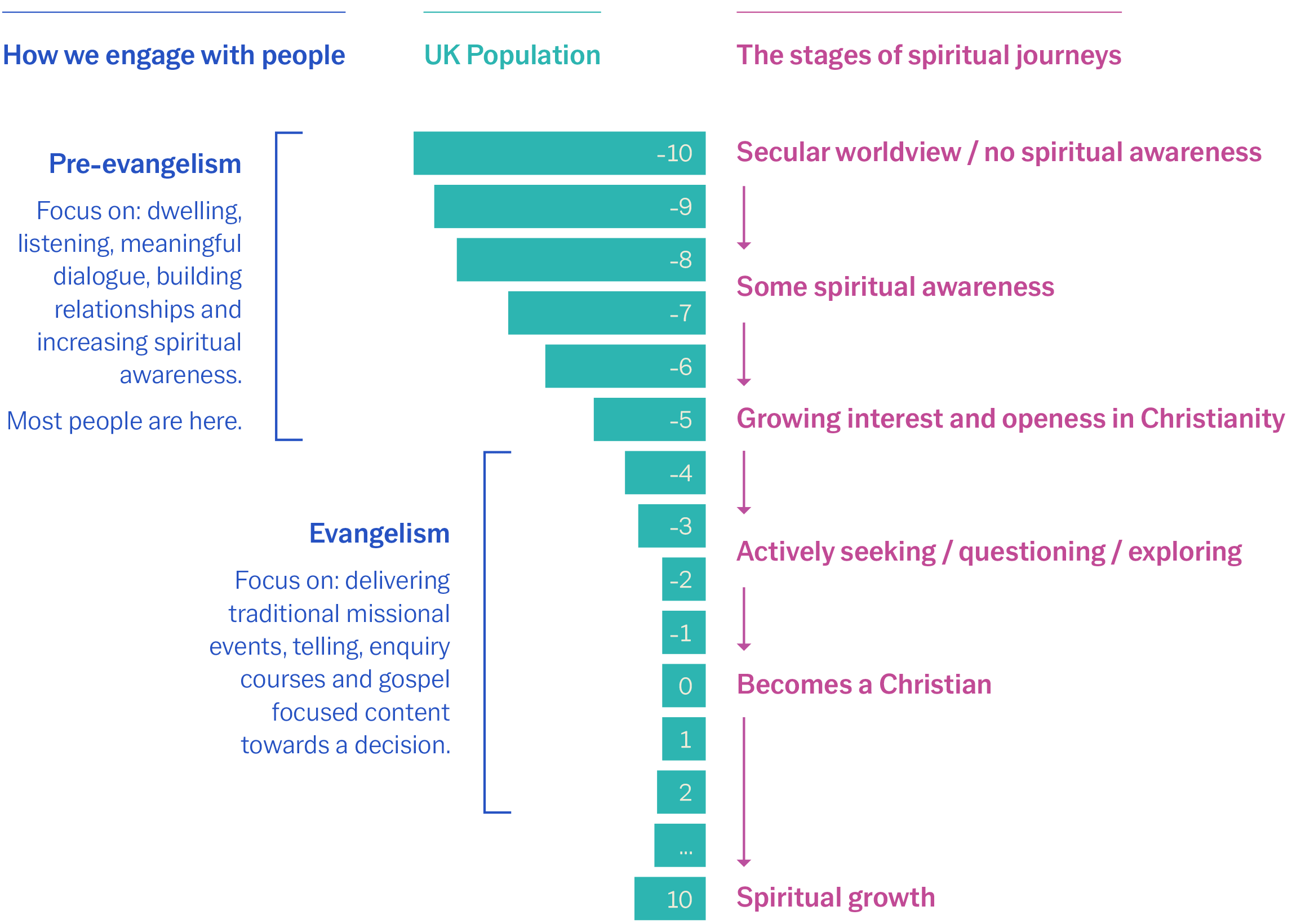
Using the Engel Scale as a guide raises several important ideas and questions.
1. People are at different stages spiritually
The people we know are likely at very different places in relation to faith. Some may only just be beginning to think about spiritual questions, while others may already have significant knowledge of Jesus and the Christian message. Within this range of knowledge there will also be wide range attitudes – including those who are hostile, indifferent, curious, disinterested, seeking and more.
2. Faith journeys are rarely straightforward
At every stage there is the possibility of both positive and negative responses. Many people move forwards and backwards in their spiritual journey. Some remain at one stage for years, while others reject moving forward (for now).
3. Different stages require different approaches
People need different kinds of support depending on where they are spiritually. Some who have little awareness of faith or spirituality will be meaningfully impacted by Christians who build relationships, listen well, and model Christian life through presence and witness. Others will be impacted by discovering the idea they are spiritual and being introduced to Christians who can talk about how faith impacts their lives. Others are particularly ready to actively exploring Christianity through discussion, and courses such as Alpha, or direct explanations of faith.
4. Many people today start further back
Although there is considerable interest in spirituality today, many people have very little understanding of Christianity or the story of the Bible. In Engel Scale terms, people often begin much further back than previous generations.
As a result, we may need to spend more time preparing the ground before we begin explaining the gospel directly. This is one of the reasons organisations such as Ugly Duckling Charity focus on pre-evangelism and creating environments where life-changing conversations can begin naturally and relationally.
5. Faith journeys are often messy and non-linear
The Engel Scale is helpful, but real-life faith journeys are rarely as neat as a chart suggests. People say “yes” and “no” to Jesus at many different points in life. Some move quickly; others move slowly. Some experience dramatic moments of change, while others come to faith almost imperceptibly over time.
This reminds us that we cannot assume everyone’s experience will look the same. Evangelism, discipleship, and spiritual growth are often relational, gradual, and messy.
Research suggests that, apart from growing up in a Christian family, many people come to faith because they are looking for help, hope, meaning, or community. This helps explain the importance of initiatives such as Resolve, The Happiness Lab, and 10:10, which create opportunities for people to engage with deeper questions of life and faith.
Friendships and relationships with Christians also remain one of the most significant influences on spiritual openness. Through authentic relationships, people witness faith lived out, ask questions, and explore Christianity in a safe environment. Others begin their journey because of spiritual experiences they cannot easily explain.
In his book Big Yes, Little Yes, Healthy Maybe, Mark Greenwood explores how people often move toward faith through many small decisions rather than one dramatic event. His framework closely reflects the thinking behind the Engel Scale:
- Healthy Maybe — openness, curiosity, or willingness to explore faith.
- Little Yes — intentional steps towards Jesus, such as attending church, asking questions, or joining a course.
- Big Yes — a decision to follow Christ and begin a life of discipleship.
For many people, faith develops through a series of smaller but significant moments rather than one single turning point. Even those who experience a dramatic 'Damascus Road' conversion can often look back and recognise how God had been working through many earlier experiences and relationships.
Perhaps, then, our strong focus on leading people to one final “yes” moment has sometimes narrowed our understanding of evangelism. Could we be missing opportunities to help people take smaller but equally important steps toward faith?
If people come to faith through different journeys and at different speeds, then we also need to think carefully about the message we are inviting them to respond to. What exactly is the gospel we are communicating? If our understanding of the gospel is too narrow, we may unintentionally reduce faith to a single moment or formula rather than an invitation into the life and Kingdom of God.
Understanding the Gospel
The gospel is meant to be good news that can be shared simply and naturally. Richard Holloway once described it as “something you could shout across the street.” At its heart, the gospel is the announcement that, through Jesus, God is restoring people, relationships, and the world.
The word gospel comes from the Greek word evangelion, meaning 'good news' or 'good announcement'. Christianity begins with the claim that something has happened in Jesus Christ that changes everything.
The gospel is the good news that, through Jesus’ life, death, and resurrection, God is reconciling people to himself and renewing the world.
The message Jesus proclaimed
When Jesus spoke about the gospel, he spoke primarily about the Kingdom of God. His message was that God’s rule was breaking into the world here and now.
For many Jewish people in Jesus’ day, the Kingdom of God carried political and national expectations. Jesus reshaped those expectations. The Kingdom was not simply about power or territory; it was about God restoring lives, relationships, communities, and creation itself.
Jesus invited people to enter this Kingdom through repentance, faith, and trust in him. He called people not only to believe differently, but to live differently.
For Jesus, the Kingdom of God meant God’s reign breaking into everyday life.
How the early Church explained the Gospel
In the book of Acts, the first Christians continued to proclaim the good news of the Kingdom. Yet their preaching focused especially on Jesus himself — his life, death, resurrection, and exaltation.
The early Christians understood Jesus as the fulfilment of God’s promises. Through him, a new age had begun. Jesus had died, risen from the dead, and been exalted to the right hand of God.
Because of this:
- forgiveness is offered
- the Holy Spirit is given
- and people are invited into a new relationship with God
The early church also believed history was moving toward a conclusion. One day Christ would return to bring justice, renewal, and judgement.
Different New Testament writers emphasised different aspects of this good news:
- Paul often spoke about salvation
- John emphasised eternal life
- while the Gospels focus strongly on the Kingdom of God
Together, these images help us see the richness of the gospel message.
Classic ways of explaining the Gospel
Christians have often used illustrations and frameworks to help communicate the gospel clearly. Some well-known examples include:
- The Bridge Illustration — humanity is separated from God by sin, but the cross of Christ bridges the gap.
- The Roman Road — a series of verses from Romans explaining sin, grace, faith, and salvation.
- The ABC Approach — People are invited to: Admit their need, Believe in Christ, Consider his call, Do something in response, and Experience new life.
These approaches can be helpful because they simplify important truths. However, they can sometimes reduce the gospel to a formula if used without relationship, story, or context.
A broader picture of the Gospel
Krish Kandiah suggests that we need to recover a fuller understanding of the gospel. He describes the good news as transforming four key relationships:
- our relationship with God
- our relationship with ourselves
- our relationship with other people
- and our relationship with the world around us
The gospel is therefore not only about individual forgiveness, but about restoration and renewal in every area of life.
At the same time, the heart of the gospel remains reconciliation with God. Every other transformation flows from that restored relationship.
The gospel changes not only where we spend eternity, but how we live today.
The Gospel as a story
Many people today do not naturally connect with religious or theological language, but they do connect with story. The gospel is ultimately God’s story:
- creation
- brokenness
- rescue
- restoration
- hope
Our task is to help people connect their own story with God’s story.
One of the most powerful tools we have in sharing the gospel is our own testimony. As we share honestly about our experiences of faith, struggle, forgiveness, and hope –people begin to see how God’s story intersects with ordinary human life.
Faith becomes more than an abstract idea — it becomes personal and lived.
Questions for Today
One of the challenges in explaining the gospel today is that many people no longer understand words such as sin. For some, the language feels outdated or meaningless.
Yet the reality behind the word remains familiar:
- brokenness
- guilt
- injustice
- selfishness
- alienation
- and the sense that the world is not as it should be
The Bible presents sin as more than isolated acts of wrongdoing. Sin affects individuals, relationships, communities, and even creation itself. In the same way, the gospel is about more than forgiveness alone — it is about healing, reconciliation, renewal, and new creation.
At its centre, the gospel remains the invitation to know God through Jesus Christ — and from that relationship flows transformation in every area of life.
Leading people into the good news story may take time. We need to begin where people are rather than where we are. Often this means starting further back, creating space for trust, conversation, and exploration around life and life across the whole Gospel story. This could be about sin and the need of salvation, but also about relationships, peace, hope, meaning, purpose, friendships, community, love and life today and beyond. There is only one way to God and that is through Christ – but there are many ways in which a person’s journey towards faith can begin.
This is why dwelling, dialogue, and different levels of invitation matter. These approaches help people take meaningful steps towards faith. In these spaces we create opportunities for us to share our own stories naturally and authentically.
As we spend time with others, the work of God in our lives begins to “rub off.” Over time this can create space for deeper conversations about life and faith – these help people move to a greater awareness of the Christian faith towards a decision for Christ that might otherwise never have happened.
As we think about helping people commit themselves to Christ, we do so knowing that conversion is ultimately the work of the Holy Spirit. For some, this may involve a clear and identifiable moment of decision. For others, it may be a much longer journey made up of many smaller steps.
Either way, we are invited to walk alongside people patiently, prayerfully, and attentively — remaining open to how God may be working in their lives, however long or short that journey may be.


Session Introduction
To fulfil the Great Commission where we live and work, there are two actions we have to do. The first is to go (to share our faith with others) and the other is to make disciples, (to help people become followers and help them grow in their following).
A disciple is a student or learner, like an apprentice. Just as an apprentice learns their trade, a Christian learns what it means to follow Christ. While modern apprenticeships end with qualification (and some learning continues throughout a career), the initial apprenticeship status is complete. Christian discipleship, however, is a lifelong journey of spiritual formation, a continuous process — an endeavour of spending time with Jesus and being transformed into His likeness. We also don’t need to have ‘arrived’ to disciple others; the Christian disciple is both apprentice and teacher.
It’s helpful as we explore discipleship to consider how faith formation occurs at different life stages, both chronologically and spiritually. We should regularly reflect on our discipleship: Where do we need to begin? Where are we growing? In what areas do we feel ourselves deepening? Where is our discipleship evident (or not)? What do we still need to learn?
Referring back to ‘Decision’, you may recall the Engel Scale and how it plots the journey to faith from -10 to 0. It also plots the discipleship journey from +1 to +10. (i.e, joining the church, conceptual and behavioural growth, communion with God, living life as a believer, serving, etc). However, we must avoid the trap of thinking we’ve ‘arrived’. Or that others must arrive. We should cultivate faith communities that nurture believers at every stage, fostering a culture of discipleship for new and seasoned followers alike. We become learners together, helping each other become more like Jesus.
While we often associate discipleship with new or committed Christians, the process can begin before formal conversion. People might follow from a distance or adopt Christian practices before believing. These practices, often viewed as hallmarks of a disciple, can draw those who don’t yet know Jesus closer to Him.
For example, many learn to pray or read the Bible before believing, yet these practices are central to discipleship. Perhaps our mission should prioritise helping people engage with these practices before conversion, not just after.
Thinking about discipleship within mission shifts the focus from reciting a gospel formula (though truth is essential) to modelling the Christian life and inviting others to do the same. This can involve engaging in discipleship practices that lead people to Jesus. If discipleship is about faith formation as well as information, our mission should focus on facilitating formation, not just imparting information.
Our discipleship, therefore, involves personal growth, helping others grow in their faith, and drawing those who don’t yet believe onto the discipleship journey, teaching them the ways of Jesus. The crucial question is: how do we ensure that this discipleship happens? In this session we explore what it means to be disciples and how do we create a culture of learning. How do we make disciples, that go and make disciples?

Discipleship
In exploring this theme, we are asking what discipleship actually is, and how it is inseparably connected to mission and the making of disciples in everyday life. We will also ask whether discipleship is primarily the path that follows conversion—or whether it is also part of the journey that leads someone to Christ.
To fulfil the Great Commission where we live and work, we are called to do two things. First, we go and share our faith with others. Second, we make disciples by helping people follow Jesus in every area of life.
A disciple is a student or learner, like an apprentice. Just as an apprentice learns their trade, a disciple learns what it means to follow Christ. While modern apprenticeships end with qualification (and some learning continues throughout a career), the initial apprenticeship status is complete. Christian discipleship, however, is a lifelong journey of spiritual formation, a continuous process—an endeavour of spending time with Jesus and being transformed into His likeness. We also don’t need to have ‘arrived’ to disciple others; the Christian disciple is both apprentice and teacher.
It’s helpful as we explore this theme of discipleship to consider how faith formation occurs at different life stages, both chronologically and spiritually. We should regularly reflect on our discipleship: Where do we need to begin? Where are we growing? In what areas do we feel ourselves deepening? Where is our discipleship evident, and in what areas is it lacking? What do we still need to learn? What could I start to show others and help them to learn?
Referring back to the theme of ‘Decision’, you may recall the Engel Scale and how it plots the journey to faith from -10 to 0. Versions also plot the discipleship journey from +1 to +10, including joining the church, conceptual and behavioural growth, communion with God, living life as a believer, and serving etc. However, we may want to avoid the trap of thinking we’ve ‘arrived’. Or that others must arrive. We should cultivate faith communities that nurture believers at every stage, fostering a culture of discipleship for new and seasoned followers alike. We become learners together, helping each other become more like Jesus.
Discipleship as formation in practice
If discipleship is fundamentally about formation rather than information, then it is worth asking how this has been worked out historically, and why it remains such a challenge today.
During the industrialisation of the 18th and 19th centuries, many people left their livelihood in the countryside to take up employment in one of the many new factories that were opening up in nearby towns and cities. Concerned about those who found themselves in the slum housing that surrounded these new industries, George Whitefield invited his fellow evangelist John Wesley to join him in evangelising them.
The open secret of their success was Wesley’s “method” of establishing the class meeting for those who had made a decision for Christ. It was there that 6 or 7 people would gather together on a regular basis and discuss the issues relevant to their walk with Christ. It was here that they would examine their lifestyle and be supported in their following of Jesus. In many ways, these class meetings embodied what discipleship looks like when it moves beyond teaching into formation: shared life, accountability, reflection, and mutual encouragement.
Today, this concept can still be seen—though in different forms and often under different names—in many growing churches that are committed to working out how people are discipled now. This model wasn’t new either as it replicates the new testament model too — where groups of believers came together to pray, break bread and receive the apostles teaching.
The challenge of discipleship today
Whether it is harder to disciple someone today than it has been for the last 500 years makes for an interesting discussion. Whatever you think about this, there is no doubt that there are several challenges we face in discipleship.
1. Less knowledgeable
There is today a growing lack of awareness of the Christian story. The deeper story from a Christian perspective—of our existence, of why we are here, of who we are, and of what the future holds for us—is missing in the understanding of most people.
2. Less of a Christian culture
Christianity once dominated our culture but today it has become more marginalised and alongside a broad range of views that are easily available for people to adopt the result is a culture increasingly shaped outside a Christian worldview.
3. Less of a Christian conscience
In earlier generations, even those who were not practising believers often operated within a moral framework shaped by Christianity. Today, fewer people have a conscience formed by that influence, meaning discipleship cannot assume shared moral or spiritual foundations.
4. Life skill challenges
Some people will lack the basic life skills that underpin discipleship practices. Before someone can sustain a daily devotional life, they may need to learn time management — or at least how to switch off from distractions. Before faith-sharing, they need to learn how to hold a conversation. Before financial stewardship, they must learn financial literacy. Discipleship is therefore also deeply practical and holistic and has to take into account peoples different abilities.
5. An outdated information-based model of discipleship
Much of modern discipleship assumes that information alone produces transformation. The belief was that if someone was taught the “A, B, C, D, E” of following Jesus, they would become disciples. While truth is essential, information alone does not form disciples.
Today we need to recognise again that discipleship requires more than teaching—it requires formation through practice, relationships, and embodied rhythms of life.
What effective discipleship requires today
To properly grasp the discipling of people today, it will be important for churches to think more intentionally about the structures that support formation. This includes discovering people’s stories, identifying their needs, and creating appropriate support mechanisms so that they can grow as the missionaries God calls them to be in their world. The thoughtfulness with which we are attempting to evangelise our friends needs to continue into their discipleship.
This may also require rethinking roles within the church—ensuring that there are people who are specifically focused on the personal development and discipleship journey of others, not just their instruction.
Mission and discipleship
You might be thinking, why include a section on discipleship in resource about mission. The reason for its inclusion isn’t just to bring the faith journey full circle as it were, but also to think about how discipleship could be happening before people even come to faith.
Although we often separate mission and discipleship into distinct phases, in practice they are deeply intertwined: discipleship is both the goal and the means of mission, and mission is the natural environment in which discipleship starts to take place. This means that when we speak about mission, we are already speaking about forming people into the way of Jesus (discipleship). While we often associate discipleship with new or committed Christians, the process can begin before formal conversion. People might follow from a distance or adopt Christian practices before believing. These practices, often viewed as hallmarks of a disciple, can draw those who don’t yet know Jesus closer to Him. For example, many learn to pray or read the Bible before believing, yet these practices are central to discipleship. Perhaps our mission should prioritise helping people engage with these practices before conversion, not just after.
Thinking about discipleship as a missional tool — shifts the focus from reciting a gospel formula to modelling the Christian life and inviting others to do the same. This can involve engaging in discipleship practices that lead people to Jesus. If discipleship is about faith formation as well as information, our mission should focus on facilitating formation, not just imparting information.
Our discipleship, therefore, involves personal growth, helping others grow in their faith, and drawing those who don’t yet believe onto the discipleship journey, teaching them the ways of Jesus — not as an end result of mission but as part of mission itself.


Session Introduction
If you have ever held a stress ball (a type of special foam that is moulded into a shape that you can squeeze in your hand), you will know that as you exert pressure,
it will change shape — but the moment you let go, it reverts back to its original form.
As individuals and churches, we have a shape. We have been moulded personally by our culture, up-bringing, other influences, and, hopefully, by our faith. Our churches have a shape too. Hopefully, at the core will be our beliefs about God, but we also have practices, ways of doing things, traditions and styles shaped by our type of church, denomination or history.
Over our lifetimes, we form habits that are healthy or unhealthy, Spirit-led or human-led, and these shape our way of living. This includes our approach to the mission. Koble has provided you with an opportunity to press into some missional themes, and hopefully ‘squeezed you’ to think and look at things differently. However, there is always a danger that, once we have explored a subject like mission, we ‘let go’ and revert to our previous shape — one that we find familiar and comfortable.
Yet, to connect with those outside of the church and help people journey to faith, we may need to keep the pressure on our personal and church shapes to prevent us from reverting back to type. This may mean doing some things differently and continually reminding ourselves to listen for the voice of God and look for the hand of God at work. We need to give space to let God guide and squeeze us into the missional community we need to be where we live.
That is why, for each of our Ds, we have encouraged, reflection, discussion, the reading of scripture, prayer, and practical ideas — not only to bring each theme to life but also to help reshape us.
In this final D, we will recap and explore the opportunities for each D in your context. This will help you to consider practical steps you can take, encouraging you to identify and discern at least three things that you could focus on under each D to keep pressing in to mission. This will help to prevent you and your church from springing back into your previous shape.
Importantly this is not the end of the journey but the beginning. It is time to focus on Direction and discern God’s missional shape for your life and context — after all, the fields are white unto harvest but the workers are few.